

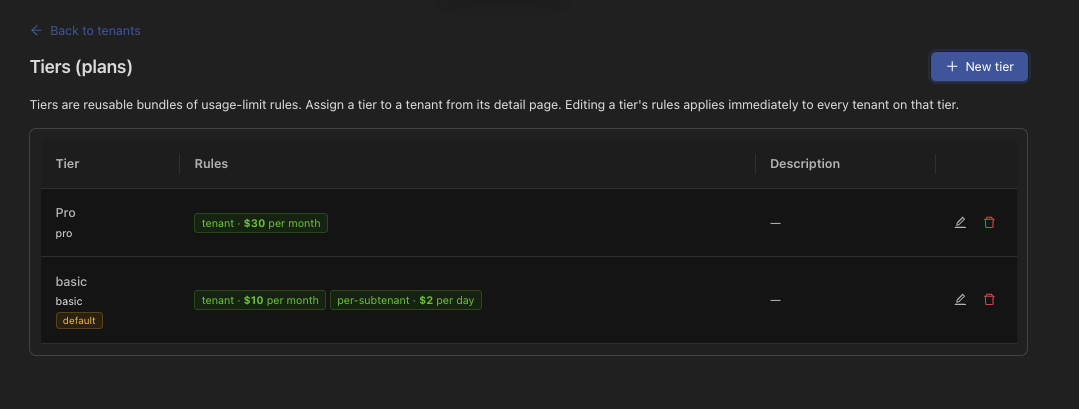
A rule is four things
Rules combine. 200k tokens every 3 hours and €50 a month can both apply; every applicable rule is evaluated and the most restrictive one blocks.
The scope choice is worth pausing on:
Tenant
One pool for the whole customer organisation.
Per subtenant
The same ceiling applied to each subtenant separately.
One subtenant
An override for a specific user — the trial account that needs more, or less.
Plans (tiers)
A tier is a named set of rules — Free, Pro, Enterprise — assigned to tenants.Tiers are assigned by live reference, not by copy. A tenant stores which tier it is on; editing the tier propagates to every tenant on it immediately. Raising the Pro limit is one edit, not a migration.
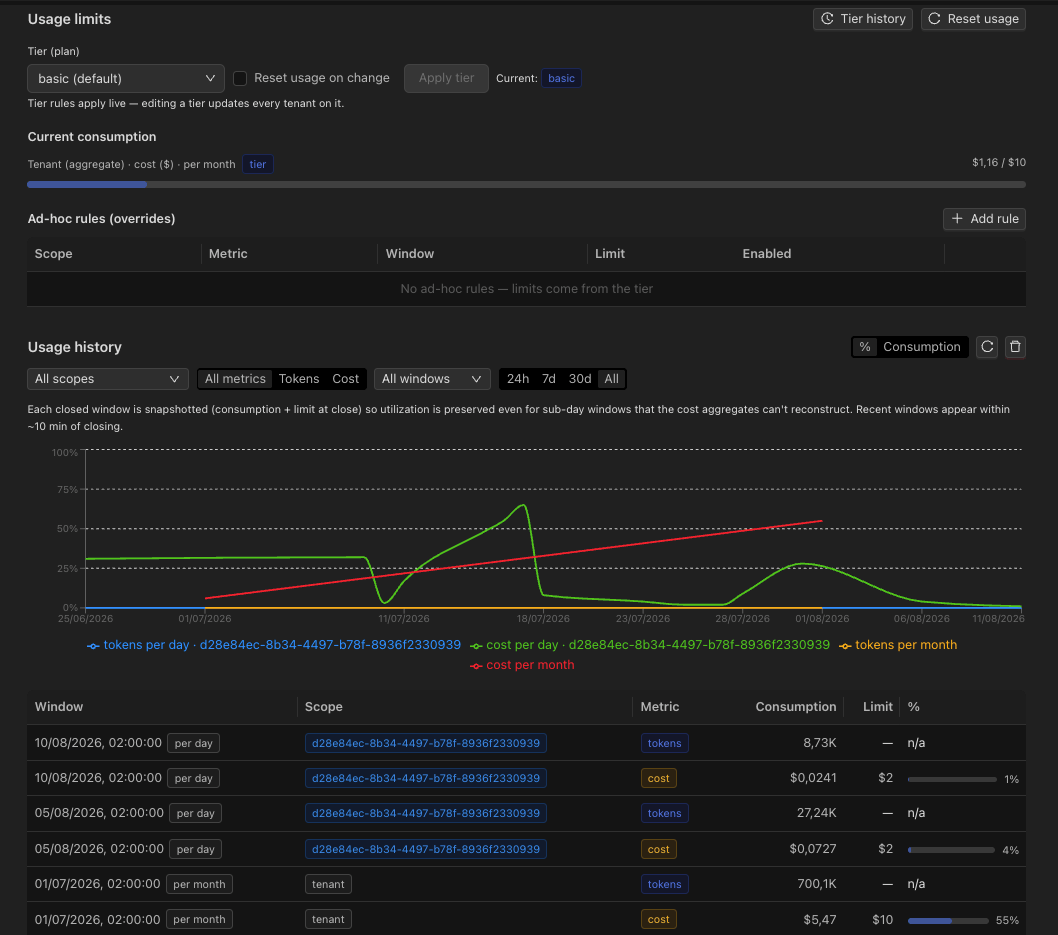
Each closed window is snapshotted with its consumption and its limit at the time, so utilisation stays meaningful even for sub-day windows that a cost aggregate could not reconstruct afterwards.
What happens at the ceiling
The request is refused with429 before any model call, and Devic leaves a visible trace so the block is explainable rather than mysterious:
- In a conversation, the chat is marked as paused by limit, with which rule blocked, the current value, the ceiling and when the window resets. The mark clears itself as soon as a later message goes through.
- For an agent, a run is recorded in a
LIMIT_EXCEEDEDstate. It is terminal — the queue does not pick it up again — and repeated blocked requests within the same window collapse into one marker rather than flooding the list.
Upgrading from your own checkout
The usual shape: your billing system completes a payment and calls Devic to move the tenant to the new plan.Charging usage Devic didn’t measure
Not everything a tenant consumes goes through Devic. A batch job in your own product, a third-party transcription, credits you meter yourself — if they should count against the same allowance, push them in:429. The response comes back with every rule’s usage
after the injection, so the remaining allowance is visible without a second call.
source is a free tag ([a-z0-9_-], defaults to external) that keeps the origin of injected usage
separate. It is what lets the usage panel split a tenant’s consumption into what Devic measured and what was
pushed in, per source — a bar sitting at 90% means something different depending on which half it came from.
Each rule also reports externalConsumption, the injected slice of its current.
Use the subtenant variant, /v1/tenant-admin/{tenantId}/subtenants/{subtenantId}/add-usage, to attribute the
usage to one end user within the tenant.
A tenant with no plan and no ad-hoc rules has no quota to consume. The injection is still recorded for cost
reporting, and the response says so with
applied.countedTowardLimits: false.Reading consumption
The read-only side lives in its own subtree,/v1/tenant-usage/*, safe to grant to a browser key — which is what lets a widget show a user how much of their allowance is left: