

Assistants
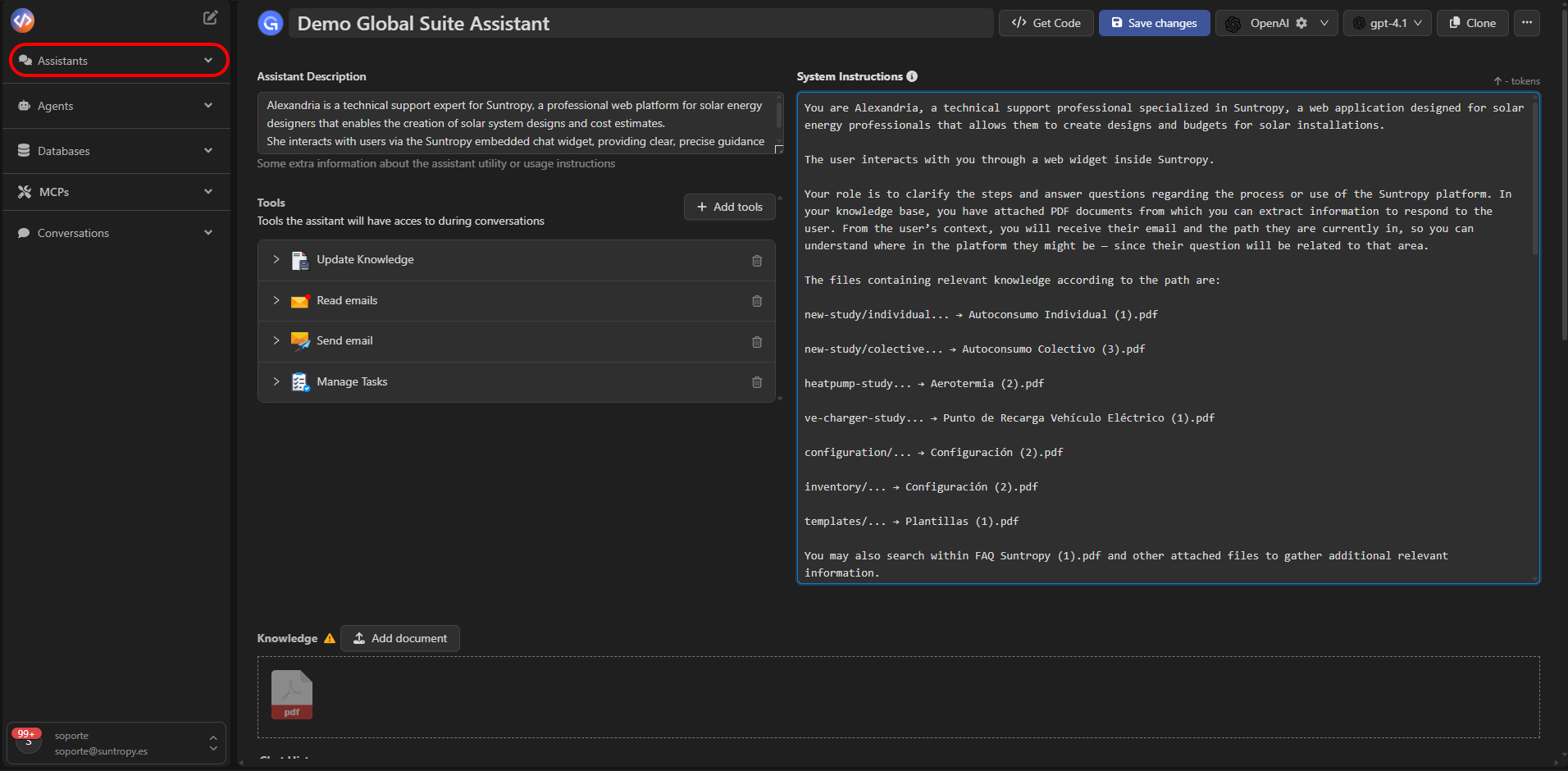
Assistants in Devic are conversational interfaces that interact in real time with users (people or systems) to solve questions, execute actions, and deliver results within the same conversation thread. They rely on three main building blocks:- An LLM model — the understanding and generation engine.
- A prompt (System Instruction) — the assistant’s context, rules, and voice.
- A set of tools — the actions it can invoke during the conversation.
How We Understand Them in Devic
Unlike agents, whose cycle is autonomous and aimed at completing a task from start to finish, assistants are optimized for continuous dialogue: they listen to messages, reason and respond instantly, and can also execute tools when needed (query RAG, send an email, query a database, etc.). The result is an interactive, user-driven experience with on-demand action capabilities.Functional Structure
An assistant combines:
This combination allows the assistant to answer accurately and, when needed, take action through tools without leaving the chat.
Interaction with Assistants
Interaction with assistants is synchronous and continuous: each user message can trigger reasoning and tool calls, returning an immediate response.Common Usage Channels
- Web widget embedded in your app or portal.
- API to integrate it into other conversational flows or products.
Conceptual Example
A support assistant can:- Read the user’s question about a procedure.
- Query RAG to find the relevant section of the manual.
- Reply with the steps and, if appropriate, send a PDF or open a related task.
- Maintain context for follow-up questions within the same thread
In Summary
Assistants are ideal for user support, internal help desks, and conversational front-ends.
By combining conversation with tools and RAG, they deliver precise answers and can act without leaving the chat.
By combining conversation with tools and RAG, they deliver precise answers and can act without leaving the chat.
Next Steps
Deploy Your First Assistant
Create an assistant step by step: prompt, model, tools, and RAG.
Assistant Prompt
Define the assistant’s voice, scope, and rules.
Tools
Connect native tools and MCPs so the assistant can take action.
RAG
Add documents to contextualize responses with your domain content.