

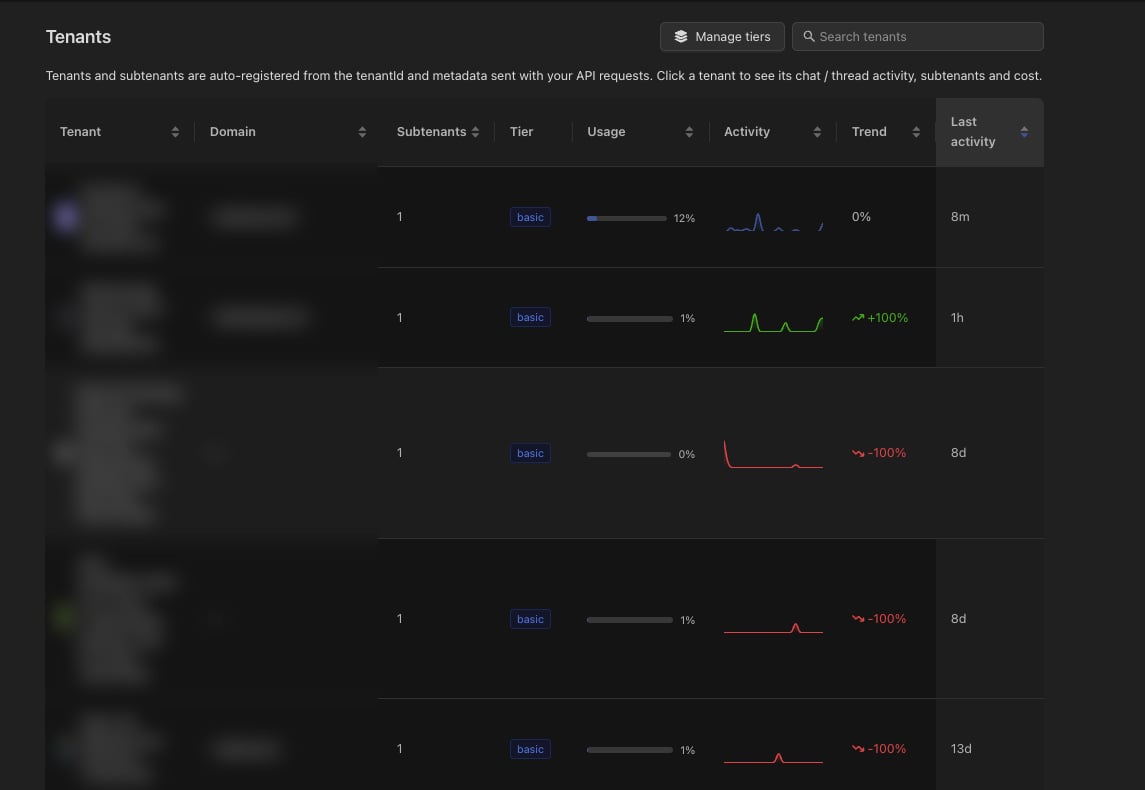
Tenants register themselves
You do not create tenants. The first time a message or an agent run carries atenantId, Devic records it and starts attributing to it.
Attribution is forward-only. A tenant starts accumulating cost from the moment it first appears — traffic that arrived before it was identified is not retroactively assigned.
What Devic keeps about them
Devic fills in what it can and lets you correct it: a display name, an email, a logo, and the corporate domain inferred from the subtenants’ addresses. The inference is deliberately conservative — it needs at least two distinct subtenants sharing a non-generic domain, so one person with a Gmail address never turns into a company. Edit a field by hand and the automatic detection stops touching it.The three things you get for free
Cost per customer
Daily and monthly cost by tenant and subtenant, broken down by agent and assistant.
Isolation
Memory, connected apps and conversations are partitioned by tenant by default.
Limits
Consumption ceilings per plan, enforced before the model is called.
Next steps
Usage limits and plans
Tiers, windows and what happens when someone runs out.
Tenant sessions
Proving which customer is calling, instead of trusting the browser.
Memory buckets
How memory is partitioned along the same axes.
Integrations per end user
Each customer connecting their own accounts.