> ## Documentation Index
> Fetch the complete documentation index at: https://docs.devic.ai/llms.txt
> Use this file to discover all available pages before exploring further.
# What They Are
> Organize your integrations and tools under the Model Context Protocol (MCP) standard to connect agents and assistants with external or internal services.
## Overview
The **Model Context Protocol (MCP)** extends the capabilities of language models by enabling them to execute actions on external or internal systems.
In Devic, MCPs act as **integration interfaces** that connect agents and assistants with APIs, services, or custom functions.
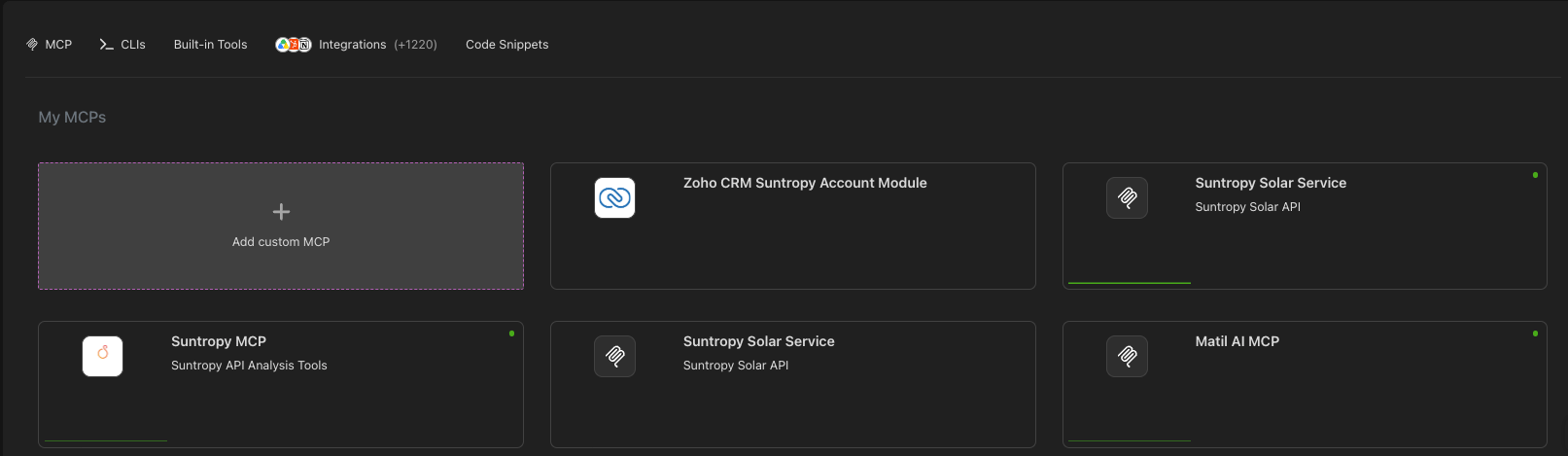 The **MCP** tab holds two sections, depending on who runs the server:
Servers you build. Point Devic at your own API — an OpenAPI definition is enough — and it becomes an MCP server whose tools the models can call. Devic hosts it.
Servers somebody else runs. Give Devic the URL of a remote MCP server, authenticate once, and its tools join the catalogue as if they were local.
***
## The rest of the tabs
Beside MCP, the same section carries everything else an agent can be given:
| Tab | What it holds |
| ------------------ | ------------------------------------------------------------------------------------------------------------------------------------------------------------------------------------------ |
| **CLIs** | Command-line tools made available inside an [environment's sandbox](/devic/environments/clis). |
| **Built-in Tools** | Native tools that need no server at all — sending email, generating a PDF from HTML, reading a spreadsheet. See [Built-in Tools](/devic/mcps/built-in-tools/index). |
| **Integrations** | A catalogue of over a thousand ready-made apps — Google Calendar, HubSpot, Jira, Slack — connected by OAuth rather than configured by hand. See [Integrations](/devic/integrations/index). |
| **Code Snippets** | Small pieces of code exposed as tools. Available in Developer Mode. |
**MCP Gateways** used to live here and now sit under [AI Governance](/devic/ai-governance), which is where the sessions and tool calls they record are reviewed. See [MCP Gateway](/devic/mcps/mcp-gateway).
***
## Using MCPs
Once created, connected or imported, MCPs become available to the agents and assistants you attach them to.
They can be invoked through natural language or integrated into automated workflows.
Agents execute MCP tools autonomously within their business logic.
MCPs can be published and shared with other environments —for example, ChatGPT or third-party services— through an access URL.
***
Learn how to create your MCP automatically from an OpenAPI definition.
The **MCP** tab holds two sections, depending on who runs the server:
Servers you build. Point Devic at your own API — an OpenAPI definition is enough — and it becomes an MCP server whose tools the models can call. Devic hosts it.
Servers somebody else runs. Give Devic the URL of a remote MCP server, authenticate once, and its tools join the catalogue as if they were local.
***
## The rest of the tabs
Beside MCP, the same section carries everything else an agent can be given:
| Tab | What it holds |
| ------------------ | ------------------------------------------------------------------------------------------------------------------------------------------------------------------------------------------ |
| **CLIs** | Command-line tools made available inside an [environment's sandbox](/devic/environments/clis). |
| **Built-in Tools** | Native tools that need no server at all — sending email, generating a PDF from HTML, reading a spreadsheet. See [Built-in Tools](/devic/mcps/built-in-tools/index). |
| **Integrations** | A catalogue of over a thousand ready-made apps — Google Calendar, HubSpot, Jira, Slack — connected by OAuth rather than configured by hand. See [Integrations](/devic/integrations/index). |
| **Code Snippets** | Small pieces of code exposed as tools. Available in Developer Mode. |
**MCP Gateways** used to live here and now sit under [AI Governance](/devic/ai-governance), which is where the sessions and tool calls they record are reviewed. See [MCP Gateway](/devic/mcps/mcp-gateway).
***
## Using MCPs
Once created, connected or imported, MCPs become available to the agents and assistants you attach them to.
They can be invoked through natural language or integrated into automated workflows.
Agents execute MCP tools autonomously within their business logic.
MCPs can be published and shared with other environments —for example, ChatGPT or third-party services— through an access URL.
***
Learn how to create your MCP automatically from an OpenAPI definition.